
Each Month We Pull Together 10 Insights Impacting The Investment Property Market
1. The Market is Cooling, But Not Uniformly
Australia’s housing market recorded its sixth consecutive month of declines in September, with national dwelling values down 1.1% according to Cotality and 0.2% according to PropTracken. However, performance varies significantly by location, with Darwin and many regional markets continuing to show resilience. As Michael Yardney notes, market conditions can vary considerably between suburbs and property types, even within the same city.
2. Listings Increase as Time to Sell Stretches
Cotality reports national new listings are almost 8% lower, year-on-year, while total listings are 19% higher year-on-year. These percentages reflect the longer time properties are taking to sell. Rate Money summarises that the national median selling period reached 39 days in September, an 11-day increase year-on-year. These conditions are also impacted by weaker buyer demand and increased borrowing costs, as well as an increase in vendor discounting, which, taken together, are enabling greater choice and negotiating power for buyers.
3. Weekly Clearance Rates Indicate Private Treaty Sales Favoured
According to Cotalities monthly housing chart pack, auction clearance rates have held between 45-50% since July, with October averaging 48% across capital cities. Domain’s data indicates more sellers are choosing private treaty from the beginning and points to another trend, the auction-to-private-treaty conversions, as a clear shift in the market.
4. Regional Markets Remain Resilient
While combined capital city prices remain weaker, regional markets are holding up considerably better. PropTrack reported regional home values were still 5.1% higher annually in September, with affordability advantages, migration trends and lifestyle preferences continuing to support many regional centres.
5. Lending Activity is Signalling Weaker Demand
The latest Australian Bureau of Statistics lending data showed total new housing loan commitments fell 5.4% in the June quarter, while investor lending dropped 8.6%. Reduced borrowing capacity, higher interest rates and affordability pressures are limiting buyer activity across many markets. Lending data is often a leading indicator for future market movements, that can signal demand conditions before changes appear in prices.
6. Rents Keep Rising as Renters Hit Limits
SQM reports national weekly asking rents increased 6.9% year-on-year in September. Capital cities were up 4.9% year-on-year, with houses up 6% and units up 3.6%. PropTrack’s Terri Scheer Investor Report indicates that gross rental yields have increased, as home prices softened and rents rose.
Despite this, Domain data suggests rental affordability constraints are increasingly limiting renters’ ability to absorb further rent increases. Rents in Melbourne, Brisbane, Perth and Adelaide flatlined in the last three months, despite the tight national vacancy rate. The ABC reports that renters are increasingly moving to more affordable locations, entering share housing arrangements or living with parents to manage rising housing costs.
7. National Rental Vacancies Increase by 0.1%
SQM Research reports that the national vacancy rates for September have increased to 1.4%. The increase in rental availability suggests rental conditions may be gradually easing in some parts of the country, but not all. Sydney (1.8%), Melbourne (1.9%) and Canberra (1.9%) have the highest vacancy rates, although all remain below what’s generally considered a balanced market (around 3% vacancy).
Brisbane, Perth, Adelaide, Darwin and Hobart continue to have vacancy rates below 1%, meaning constrained market conditions for renters, with limited supply.
8. Latest Round of Rental Reform Laws in Victoria
From 13 October, the latest changes in rental laws have come into effect in Victoria. These rules cover gas and electrical safety checks, compliance with minimum rental standards and strengthened bond claims. The full list of changes is available online.
9. Households Remain Resilient, Cycle Set by Buyer Demand
The Reserve Bank of Australia released its latest Financial Stability Review, reporting that Australia’s financial system holds ‘a good degree’ of resilience. Global and operational vulnerabilities have been identified as risks, with geopolitical tensions and rapid changes in technology adding complexity. The report found households with mortgages remain well placed to manage difficult conditions. Cost of living pressures remain elevated, and real household disposable income has declined over 2026. PropertyInvestmentProfessionals interprets this as a sign that buyer demand and investor behaviour may play a larger role in determining the market floor than forced sales.
10. Construction Costs Remain a Key Market Risk
Cotality’s latest Cordell Construction Cost Index (CCCI) notes construction costs accelerated to 1.0% in the September 2026 quarter and highlights continued pressure on builders’ margins from labour, material and overhead costs. The index is a quarterly measure of how residential construction costs are changing across Australia and tracks movements in the cost of constructing a typical new dwelling. The latest cost growth remains well below post-pandemic highs.
Bonus insight: A Broader Perspective on the Recent Decline in House Prices
Australia’s housing market could experience peak-to-trough falls of up to 15%. Even if values were to fall by 15% from peak to trough, prices would remain significantly higher than pre-pandemic levels.
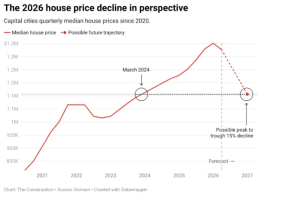
Source: The Conversation