

Australia’s ageing population is creating a need and opportunity to reshape housing supply, but attracting downsizers requires more than simply building properties with fewer bedrooms.
These buyers are increasingly looking for homes that offer convenience, flexibility and a compelling lifestyle.
By 2050, 35% of Australians are expected to be aged 55 and over, up from 29% in 2025. And by 2070, those aged over 55 are expected to outnumber those aged 25 to 54.
As household sizes decline and people live longer, the needs of older Australians will play an increasingly important role in shaping housing demand.
Despite these shifting demographics, the housing market is still not set up to meet the needs of many older Australians.
Older households typically occupy homes with more space than they require, while younger families face greater competition for suitable housing.
Research by over-50s lifestyle resort operator GemLife and REA Group highlights this mismatch, as well as the opportunity to encourage more Australians to move into homes better suited to their changing needs.
A mismatch between households and housing
Almost nine in 10 households aged 55 and over have at least one spare bedroom, while 60% have two or more, according to the Australian Bureau of Statistic’s Survey of Income and Housing.
In comparison, just 33% of households aged 25 to 54 have two or more spare bedrooms, while 31% have none spare or an insufficient number of bedrooms.
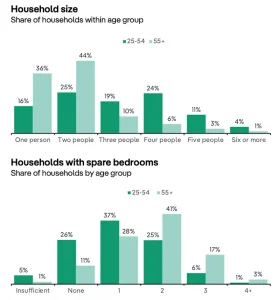
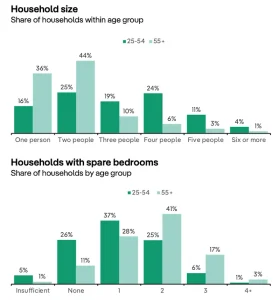
This suggests that a better allocation of existing housing could help address some of the pressure on larger households that require bigger homes.
GemLife reports that 88% of the homes that were sold by its customers in 2026 were purchased by owner-occupiers, illustrating how downsizing can return established properties to the market for other buyers.
Lifestyle matters as much as size
For prospective downsizers, the appeal of moving is often about gaining time and independence, rather than just reducing overall living space.
According to realestate.com.au’s 2026 Property Seeker Survey, low-maintenance living is the main priority for downsizers, cited by 79% of respondents, followed by security and peace of mind (62%), and proximity to amenities (61%).
Access to healthcare is particularly important, with 46% of downsizers prioritising proximity to medical services, compared with 27% of all buyers.
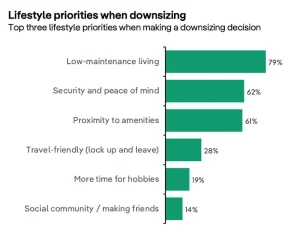
Garages, air-conditioning, and sufficient bedrooms also remain important, while buyers aged 60 and over place greater emphasis on features such as solar energy and water tanks, ensuites, and the quality of finishings compared to those aged 50-59.
Location is equally important, with access to shops, healthcare, family and community important to downsizers.
For some, this means moving closer to adult children, for others, it means being able to travel more, spending less time on maintenance or finding new social connections.
Barriers to downsizing extend beyond affordability
Despite the potential benefits, downsizing remains a difficult decision for many households. The hassle of moving and stamp duty costs are among the largest barriers, cited by 29% and 26% of downsizers. Emotional attachment to the family home (22%) and reluctance to leave an established community (20%) are also key concerns.
Transaction costs are particularly significant because they can discourage households from moving, even when their existing home no longer suits their needs.
Research by the e61 Institute and PropTrack found that a one percentage point increase in stamp duty rates reduces housing turnover by approximately 7%. Reducing these costs for downsizers could be another key step towards improving housing mobility.
An opportunity for housing providers
While alternative housing models designed to meet the needs of older Australians may appeal to downsizers, providers need to address concerns around ongoing fees, community rules, and ownership agreements which can deter prospective residents.
The strongest offerings will combine practical home design with transparent costs, convenient locations and facilities that support independence and social connection.
Importantly, downsizers still want to retain the features of a home that still matter to them: outdoor space, garages, storage, and room for visiting family and friends.