“We use interest rates because they get into everywhere, they get into all the nooks and crannies, eventually they’ll have an impact on all parts of the economy,” she explained.
It comes as the Reserve Bank continues to raise its concerns about Australia’s stalling productivity, slow economic growth and ability to manage both domestic and international inflation pressures.
“Capacity pressures are manifesting as inflation, we know that’s happening,” Dr Hunter warned. “Growth has also slowed down in the first half of the year; we were expecting that. The housing market has now gone into a cyclical downturn and that’s going to dampen activity into the future.”
Dr Hunter, who provides economic analysis and advice to the RBA’s monetary policy board but does not sit on it, says it is weighing up the above risks in particular.
“Even though they didn’t hike the cash rate in August they are still very concerned about inflation and we think all the risks are skewed to the upside,” she warned.
RBA assistant governor Sarah Hunter says the central bank is weighing up options. Picture: NewsWire/Martin Ollman
Risks that point to the upside rather than the downside mean the Reserve Bank is concerned inflation could be higher than statistics show.
It will be a challenge for the board to accurately determine the position of inflation when it meets next Tuesday, with the most recently published inflation data only covering the month of July.
Data for August – crucial for the RBA’s forecasts – will not be published until 30 September, the day after the RBA’s next cash rate decision.
While three of Australia’s big four banks and a number of economists believe the monetary policy board will keep rates on hold until it has seen the data, markets were pricing in an 88% chance of a rate hike on Tuesday.
An upwards move would mark a grim milestone for Australian borrowers – the highest interest rates seen in close to 15 years.
“The board have been clear they will definitely be considering either or not they have to hike the cash rate [next week],” Dr Hunter said.
“We’ll have to see what happens, but obviously we want to get inflation down.”
“There are different groups that get impacted quite differently by rates when we change them,” Dr Hunter acknowledged.
“It feels like in the next few years we’ve probably got to learn how to get a bit more comfortable with uncertainty. That’s really tough.”
Governor Michele Bullock signaled a similar sentiment in her own media appearance this week, speaking at a Committee for Economic Development of Australia event in Sydney on Tuesday.
“We need to be very careful to ensure that [monetary] policy is set in a way that minimises the second-round and indirect effects which might perpetuate ongoing inflation,” she warned.
Around a third of Australians hold mortgages and can expect minimum payments to jump for the fourth time this year if the cash rate goes up.
“Monetary policy really just needs to continue to focus on making sure that we limit indirect effects and we try to keep inflation expectations anchored.”
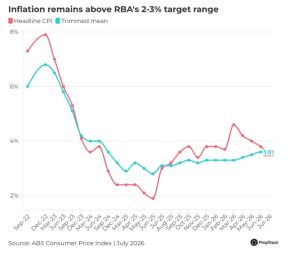
When the RBA released its most recent forecasts for inflation back in August, timelines look marginally more positive in May, with the bank now anticipating inflation will return to its 2-3% target range later next year.
The RBA’s preferred measure of inflation to consider, the trimmed mean, strips out the most volatile prices in the economy to provide a more balanced look at underlying inflation levels. Australian Bureau of Statistics data placed the trimmed mean at 3.6% for both the 12 months to June and the 12 months to July.
The higher-than-expected trimmed mean inflation in July gave the RBA the good ammunition for further rate hikes, with the door still open until proof of any cooling.
“What we really want is to get to a point where [inflation] disappears into the background, so you just don’t have to think about it, that’s what we’re aiming for,” Dr Hunter said.
“We think that as we’ve put three cash rate hikes through already and that’s helping to slow things down, and that’s what we hope is going to happen over the next couple of years.
“It might be the case that the board feel they have to raise the cash rate again to slow the economy down a bit more.”
The cash rate is expected to his 4.6% if the decision for a hike is made next Tuesday.
“We need people to understand what inflation is and how we’re trying to bring it down and be convinced that we are going to bring it down,” Ms Bullock said. “If they aren’t convinced of that, then it will perpetuate itself.”